Analysis of China’s EV Charger Market – June 2025
According to the data from the China Charging Alliance, the total number of public EV Chargers for charging infrastructure in June 2025 reached 4.17 million. The number of public EV Chargers in June increased by 91,000 compared with the previous month, an increase of 18,000 compared with June last year, with a growth rate of 50%. Currently, there are 10.6 million private EV Chargers (installed with vehicles). In June, the number increased by 285,000 compared with the previous month, with a growth rate of 9%. The average monthly charging capacity per public EV Charger in June was 1,608 kWh, which was better than the 1,461 kWh in June last year.
In recent years, China’s charging infrastructure has developed rapidly, and it has built the world’s largest number of charging infrastructure systems with the widest service range and the most complete types. Based on the ratio of the utilization rate of public EV Chargers to private EV Chargers being 3:1, the ratio of charging facilities to pure electric vehicle sales from January to June 2025 reached 0.77, basically a 1:1 relationship. Due to the surge in public EV Charger installations, the overall increase in the vehicle-to-EV Charger ratio has reached a relatively sufficient level of 1:1.
At present, the charging infrastructure still has problems such as incomplete layout, unreasonable structure, backward technology of old EV Chargers, unbalanced services, and non-standard operations, which need to be improved urgently. The repurchase rate of electric vehicles in some low-tier areas has increased. It is believed that with the continuous expansion of scale, the adjustment difficulty will be small, and the potential for electric vehicle growth will be large.
Focusing on the future trend of rapid growth of new energy vehicles, especially electric vehicles, it is necessary to further build a high-quality charging infrastructure system, update old AC low-power EV Chargers, increase the upgrade of high-power DC fast charging, better meet the needs of the people for purchasing and using new energy vehicles, and help promote the green and low-carbon transformation of transportation and the construction of a modern infrastructure system.

1. Overall Status of EV Chargers
Charging infrastructure provides charging and swapping services for electric vehicles and is an important type of transportation-energy integration infrastructure.
- In 2021, the number of public EV Chargers increased by 340,000, and private EV Chargers (installed with vehicles) increased by 600,000. The annual increase in public EV Chargers decreased by 18% compared with 2020, and the annual increase in private EV Chargers decreased by 32% compared with 2020.
- In 2022, the number of public EV Chargers increased by 650,000, and private EV Chargers increased by 1.94 million. The annual increase in public EV Chargers grew by 92% compared with 2021, and the annual increase in private EV Chargers grew by 226% compared with 2021.
- In 2023, the number of public EV Chargers increased by 930,000, with an annual growth rate of 43% compared with 2022. Private EV Chargers increased by 2.457 million compared with the end of 2022, with an annual growth rate of 27% compared with 2022.
- In 2024, the number of public EV Chargers increased by 850,000, with an annual increase decreasing by 8% compared with 2023. Private EV Chargers increased by 3.37 million compared with the end of 2023, with an annual growth rate of 37% compared with 2023.
- In June 2025, the total number of public EV Chargers for charging infrastructure reached 4.17 million. The number of public EV Chargers in June increased by 91,000 compared with the previous month, an increase of 18,000 compared with June last year, with a growth rate of 50%. Currently, there are 10.6 million private EV Chargers (installed with vehicles). In June, the number increased by 285,000 compared with the previous month, with a growth rate of 9%. The average monthly charging capacity per public EV Charger in June was 1,608 kWh, which was better than the 1,461 kWh in June last year.
2. Monthly Growth Status of EV Chargers
By the end of June 2025, the number of public EV Chargers increased by 595,000 compared with the end of 2024, showing a rapid growth rate. By the end of June 2025, the number of private EV Chargers increased by 1.36 million compared with the end of 2024, also growing rapidly.
By the end of June 2025, the number of swapping stations increased by 413 compared with the end of 2024, with a rapid growth rate in recent months.
Private charging is the dominant mode for EV Chargers. According to surveys, charging is generally done through private EV Chargers, shared EV Chargers, and public EV Chargers in residential areas or companies, each accounting for 22%-26%, totaling about 75%. The remaining respondents charge at public EV Chargers on roads outside residential areas, and some charge at public EV Chargers attached to shopping malls, cinemas, etc.
3. Analysis of Public EV Charger Characteristics in Various Regions
In June 2025, the number of public EV Chargers in Guangdong increased by 11,849, accounting for 13% of the total. In June last year, the increase was 7,000, accounting for 10%, so the share has increased this year.
There are significant differences in the situation of public charging stations in various regions, mainly due to the larger scale of charging stations in developed cities. Guangdong, Jiangsu, Zhejiang, Shanghai, and Beijing have better charging station construction. Beijing’s charging facilities have already reached a large scale with slow growth, and the same situation applies to Shanghai.
Currently, the vehicle-to-EV Charger ratio of public EV Chargers in China is much better than that in Europe and the United States, but there is a problem of insufficient utilization:
- First, incomplete coverage. Currently, 10% of highway service areas are not covered.
- Second, unreasonable structure. 99% of charging facilities are fast and slow EV Chargers, which cannot support the development of 800V and above high-voltage ultra-fast charging in the next stage.
At the micro level:
- First, high operation and maintenance costs. Dumb devices account for more than 30%, and the low degree of digitization increases the difficulty and cost of operation and maintenance management.
- Second, poor quality of traditional air-cooled devices. The service life of the devices is only 3-5 years, and operators face replacement before recovering their investment.
- Third, poor service quality. Zombie EV Chargers account for 10%, which cannot be used for charging, aggravating users’ charging anxiety.
4. Analysis of Charging Enterprise Characteristics
China’s EV Charger operators can be roughly divided into four types:
- Integrated enterprises engaged in EV Charger manufacturing and charging network investment and operation, mainly using a heavy-asset model, focusing on the operation of their own assets, and cooperating with other operators and third-party platforms, including Star Charge (affiliated to Wanbang Digital), Teld (TGOOD), Woma Charge (Woma Group), Potevio New Energy, Shanghai EV Power, Shenzhen C&D EV Power (participated by Kelu Electronics), etc.
- Power grid-owned EV Charger networks, including State Grid and China Southern Power Grid.
- Charging networks built by large automobile groups, including Tesla, NIO, XPeng, SAIC Anjoy, GAC Energy, etc. Some of these automobile groups outsource the construction and operation of their charging networks to asset-based charging operators and third-party charging service providers.
- Third-party charging network operators, such as Yunkuai Charging, Xiaoju Charging (affiliated to Didi Chuxing), Shenzhen Huineng, etc., mainly adopting a light-asset model, focusing on the huge long-tail market of EV Chargers, and providing SaaS services for regional operators, essentially being IT service providers.
The domestic EV Charger operation industry has four competitive barriers: capital, venues, power grid capacity, and data resources. Currently, the Matthew effect has emerged, with the market concentration of leading enterprises increasing. The development scale of DC EV Chargers is relatively large, and leading operators perform strongly. The average monthly charging capacity of GAC Energy’s EV Chargers reached 6,804 kWh in June, performing well every month. NIO’s EV Chargers had a charging capacity of about 2,228 kWh, and Tesla’s reached 2,872 kWh, both performing well. However, some old EV Chargers only have an average monthly charging capacity of over 100 kWh, while the main charging enterprises have an average monthly charging capacity of 1,000 kWh, resulting in a huge efficiency gap of several to dozens of times. Tesla’s monthly data remains stable and very good.
EV Chargers are subdivided into DC EV Chargers (fast charging) and AC EV Chargers (slow charging).
DC EV Chargers: large in size, with the characteristics of high voltage, high power, and fast charging, have higher requirements on the power grid, and are usually built in highway service areas, bus stations, etc., so their quantity is small, accounting for about 20%.
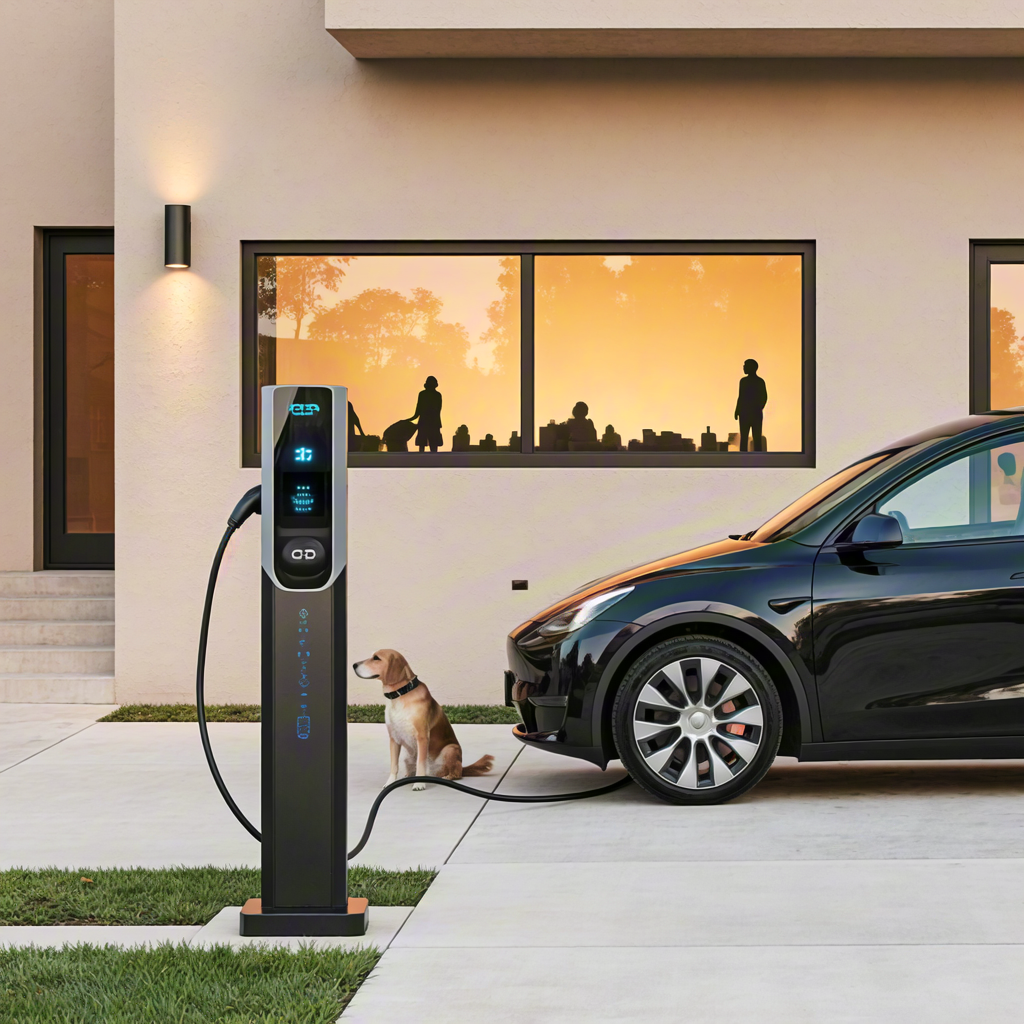
AC EV Chargers: relatively low in unit price, relatively easy to install, and usually privately owned, so they are large in quantity and widely distributed, accounting for more than 80%. From the perspective of technological development trends, DC EV Chargers are gradually moving towards high power.
From an international comparison, public dedicated EV Chargers have the best efficiency, and orderly charging for fixed charging needs such as public transportation works well. The number of public DC EV Chargers and the density of DC EV Chargers are showing an upward trend worldwide. China is in a leading position in the promotion of DC EV Chargers: for example, in 2024, the share of DC EV Chargers in China’s public network exceeded 42%.
At the same time, the Middle East has become a rising “star” in terms of DC EV Chargers: the share of DC EV Chargers increased by 7% in 2022, reaching more than 21%; the density of DC charging increased by 125%, reaching 1.3 DC EV Chargers per 100 kilometers of roads. The data in both aspects will grow further and rapidly.
5. Analysis of the Ability to Meet Demand for EV Chargers
In June 2025, domestic retail sales of pure electric passenger vehicles were 660,000 units, with 13,000 new public EV Chargers and 1.686 million new private EV Chargers built. Based on the domestic retail scale of pure electric passenger vehicles, if public EV Chargers and private EV Chargers are considered to have a 1:1 user service ratio, the vehicle-to-EV Charger ratio from January to June 2025 is 1:1, indicating that EV Chargers are relatively sufficient. It is necessary to distinguish the particularity of plug-in hybrid vehicles with less charging demand, which is the characteristic of the Shanghai model where vehicles only use fuel without charging.
However, from the perspective of subdivided functions, based on the ratio of the utilization rate of public EV Chargers to private EV Chargers being 3:1, the ratio of charging facilities to pure electric vehicle sales from January to June 2025 reached 0.77, basically a 1:1 relationship. Due to the surge in public EV Charger installations, the overall increase in the vehicle-to-EV Charger ratio has reached a relatively sufficient level of 1:1.
China’s new energy development plan clearly states that private slow-EV Chargers are the development trend, accounting for more than 90%. Currently, the development of private EV Chargers is slightly slow, which seriously affects the popularization of electric vehicles.
According to surveys, the satisfaction of users with private EV Chargers (in terms of sufficiency, layout rationality, charging price, settlement accuracy, etc.) is higher than that of other respondents. Private EV Chargers are owned by car owners, meet the need for charging at home, are usually built with the vehicle, have a large customer base, and are the absolute main force of basic charging facilities.